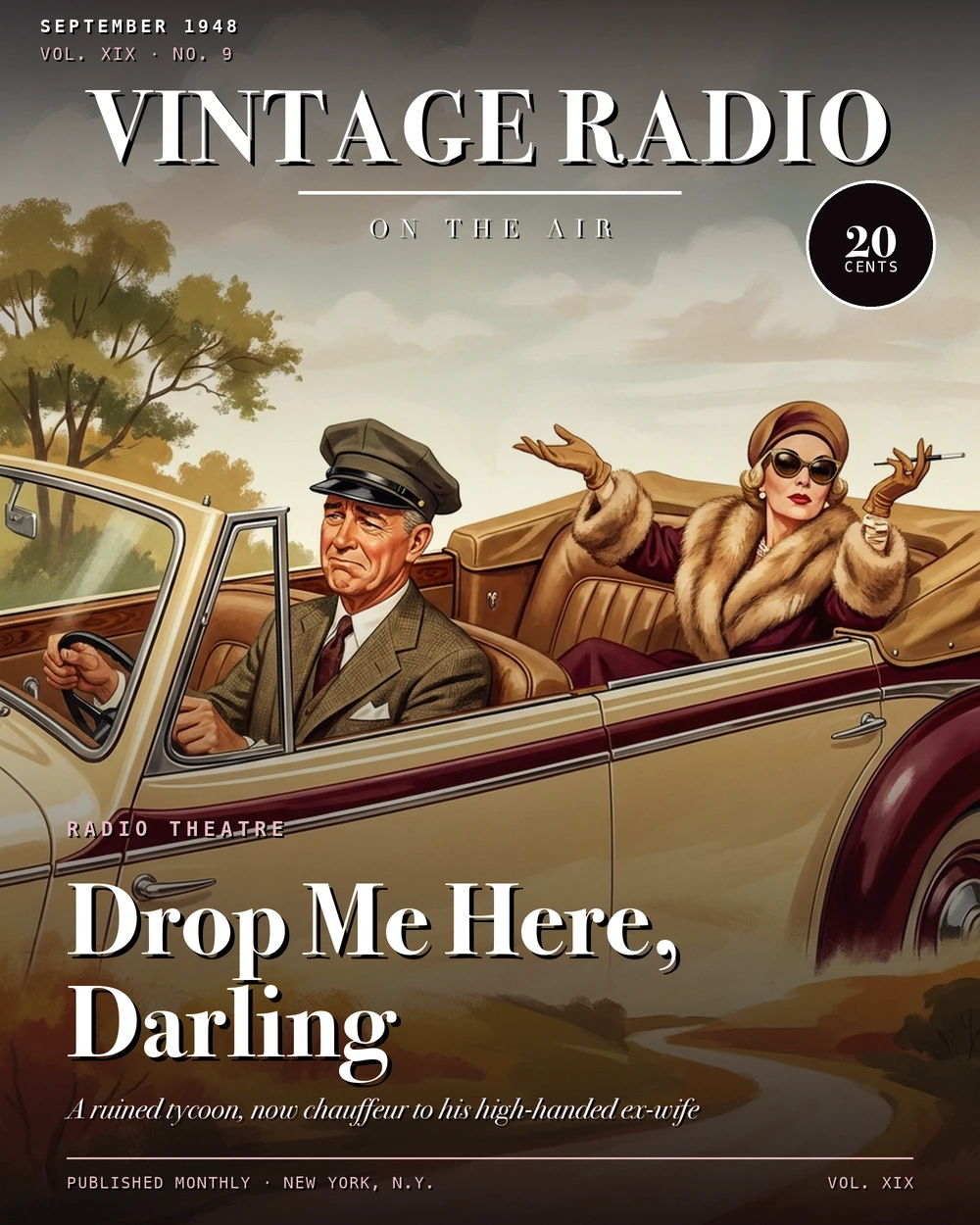
Drop Me Here, Darling
The Premise
There's a particular pleasure in a comedy built on a clean, elegant reversal, and Drop Me Here, Darling had one of the tidiest in early 1980s British radio. Leslie Duggan, once a high-flying property tycoon, is wiped out by the property crash and ends up taking a job as a chauffeur — for his own ex-wife, Caroline, who has built a successful mail-order business while he was riding high. Every morning he drives her around in her car. Every episode, the gap between where he was and where he is provides the friction that makes the comedy run.
What kept it from being simply a humiliation comedy was the relationship at its center. The Duggans are divorced but not estranged. They remain close friends, still tangled up in each other's lives, still keeping an eye on each other's love lives. The dynamic is less bitter than it is wry — two people who know each other very well, now navigating a new arrangement that neither of them could have predicted.
The series was written by Andrew Palmer and produced by Edward Taylor for the BBC. It broadcast on BBC Radio 2 on Thursday evenings at 10:00 pm, running from 2 December 1982 through February 1983. The first episode, "A Plonking Success," aired on that December premiere date, and the run comprised 13 episodes in total — one series, complete in itself, recorded in front of a live studio audience.
The Cast
The show's central pairing leaned on Leslie Phillips, who played Leslie Duggan. Phillips was already a well-established comic presence in British entertainment by 1982 — his film career in the Carry On and Doctor in the House series had made him recognizable to most of the Radio 2 audience, and his long run on the BBC radio comedy The Navy Lark (1959–1977) meant he was thoroughly at home in front of a radio microphone. The role of a once-powerful man quietly absorbing the indignity of his new situation suited his particular brand of slightly raffish, self-deprecating charm.
Jill Bennett played Caroline, the ex-wife whose financial success now underwrites the whole arrangement. The casting mattered: Caroline had to be someone whose competence was credible, not just a comic foil, and the dynamic between the two leads needed to feel like a genuine long history, not a punchline. Norma Ronald appeared in a recurring supporting role across the series, and Kenneth Connor — himself a veteran of the Carry On films — turned up in multiple episodes. The broader supporting cast included John Kane, Richard Davies, Michael Robbins, April Walker, and Joan Sanderson.
The Context
One contemporary observer described the early 1980s as producing "an astonishing proliferation of radio and TV sitcoms inspired by the idea of husband-and-wife role-reversal," and Drop Me Here, Darling fits squarely into that moment. The property crash that ruins Leslie Duggan gave the premise a specific, recognizable economic texture — British audiences in 1982 didn't need it explained. The comedy wasn't abstract; it was built on something that had actually happened to real people.
Writer Andrew Palmer was a prolific contributor to BBC Radio 2 comedy in this period. His subsequent credits include Mind Your Own Business!, which ran on BBC Radio 2 from 1987 to 1991, and Jim the Great. The combination of an experienced writer, a reliable producer in Edward Taylor, and a cast with deep roots in British comic performance gave the series a professional consistency across its run.
What Survives
The 13 episodes the series produced ranged across the situations you'd expect from the premise: Leslie taking on the chauffeur role in "Leslie Does Taxiing," getting pulled over in "Leslie is Caught Speeding," being evicted in "Leslie is Evicted," hunting for new work in "Leslie Looks for a New Job," and finding himself in charge in "Leslie the Boss." Other episodes moved into different comic territory — "The Trip to Scotland," "The Trip to Switzerland," "The Home Brew Wine Kits," "The Fitness Regime," and "Middle Age" suggest a series that wasn't content to stay entirely within the employer-employee dynamic and let the characters live a bit more freely outside it.
According to the British Comedy website, only two episodes survive in the BBC archives. That's a significant loss for a 13-episode run, and it means the series is known today more by its structure and reputation than by the bulk of its episodes. The show has been rebroadcast on BBC Radio 4 Extra, with repeats noted as recently as September 2024 — which suggests there's still an audience for what does survive, and that the BBC has kept it available to new listeners rather than letting it disappear entirely.
Drop Me Here, Darling ran for one series and left behind a thin archive, but the premise it was built on — a ruined man, a successful woman, and the comedy of a relationship that divorce couldn't quite finish — was sharp enough that it's held up as a period example of what early 1980s BBC Radio 2 sitcom could do at its most economical.